

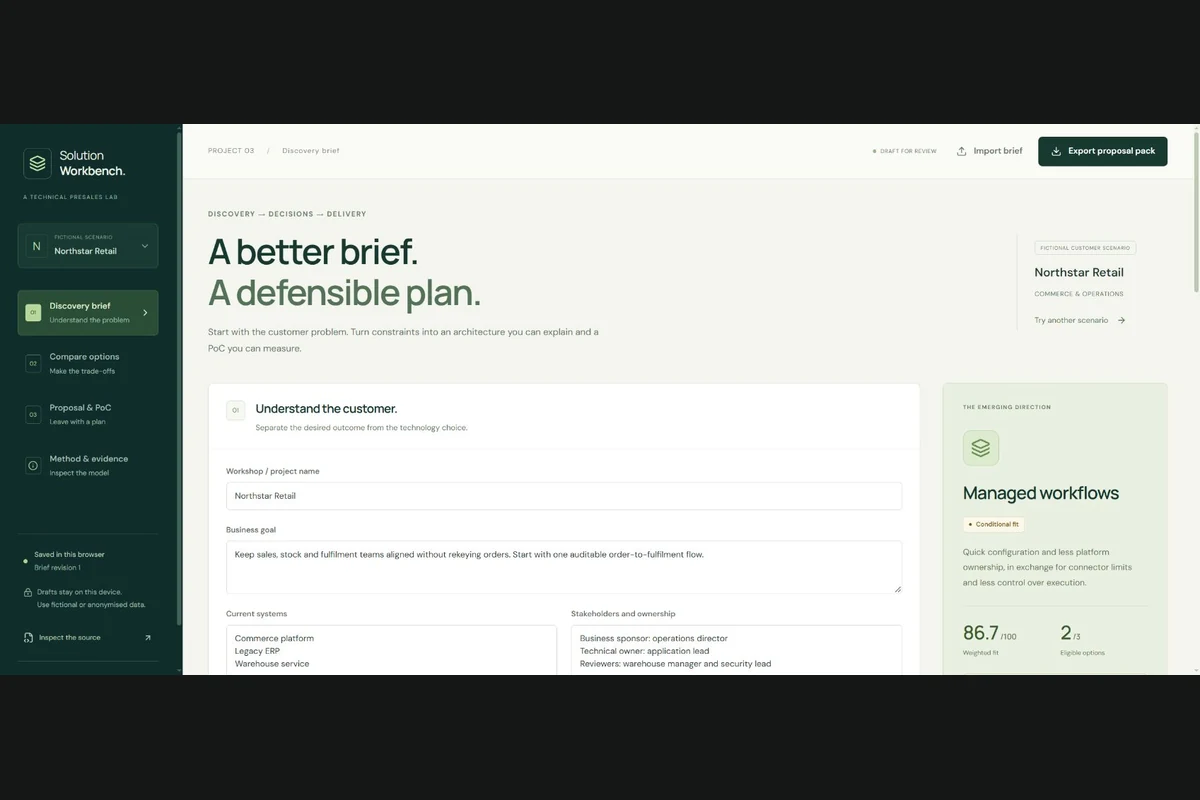
A technical proposal needs to explain why its recommended option fits the customer's constraints. Presales Workbench makes that reasoning inspectable: change a fictional discovery brief, compare the options again and follow the consequences into the proposed architecture, costs and proof-of-concept plan.
Separate feasibility from preference
The Northstar Retail scenario begins with a managed-workflow baseline as its leading option. The workbench shows the business goal, current systems, stakeholders and operating constraints behind that proposal. It also exposes the ratings and cost lines used in the comparison.
Introducing a five-second delivery requirement changes the decision. The scenario's assumed 60-second workflow baseline fails the constraint, so the cloud event blueprint becomes the proposed direction. Increasing a preference score cannot make an infeasible option meet a hard requirement.
These timings are declared workshop assumptions. They are not measured production performance or claims about a named vendor's products. Their purpose is to show how a constraint changes the reasoning.
Preserve the reason for a changed recommendation
When the new constraint is introduced, the previous brief is pinned for comparison. A reviewer can see both the original direction and the changed inputs. This makes it possible to discuss the actual decision: what became infeasible, which alternatives remain and what still needs technical validation.
The other scenarios expose different boundaries. Harbour Services becomes infeasible when platform ownership is removed. Lumen Manufacturing moves from cloud events to a private service when public cloud processing is disallowed. All three companies and their requirements are synthetic.
Keep costs traceable to assumptions
The workbench exposes planning rates, monthly traffic, peak load, growth and headroom. Cost lines reconcile in integer cents. A reviewer can change an input and inspect its effect instead of receiving an unexplained total.
The currency selector is a label and does not perform exchange-rate conversion. Rates and delivery allowances are illustrative planning inputs. The resulting proposal is not a binding quotation or an established return-on-investment calculation.
Protect the work already written
Proposal wording needs attention when discovery changes. The workbench preserves manually edited sections and flags them for review against the changed brief. This lets the author revisit assumptions without losing the wording they have already developed.
The export pack includes the brief, proposal, architecture illustration, proposed decision record, analysis and PoC plan. Re-importing the brief continues the workshop. The PoC acceptance criteria describe future tests; the export does not claim those tests have already passed.
Give the next conversation a concrete starting point
The useful output is a proposal someone can challenge. They can inspect a blocked option, question a rate, revise an operating assumption or agree which PoC check would resolve the remaining uncertainty. That is the behaviour this demonstrator is designed to expose.
Try the public Presales Workbench, read its architecture and decision notes, or inspect the recorded validation.
Continue the conversation.
Comments are hosted on GitHub. Load the discussion to read or leave a comment.