

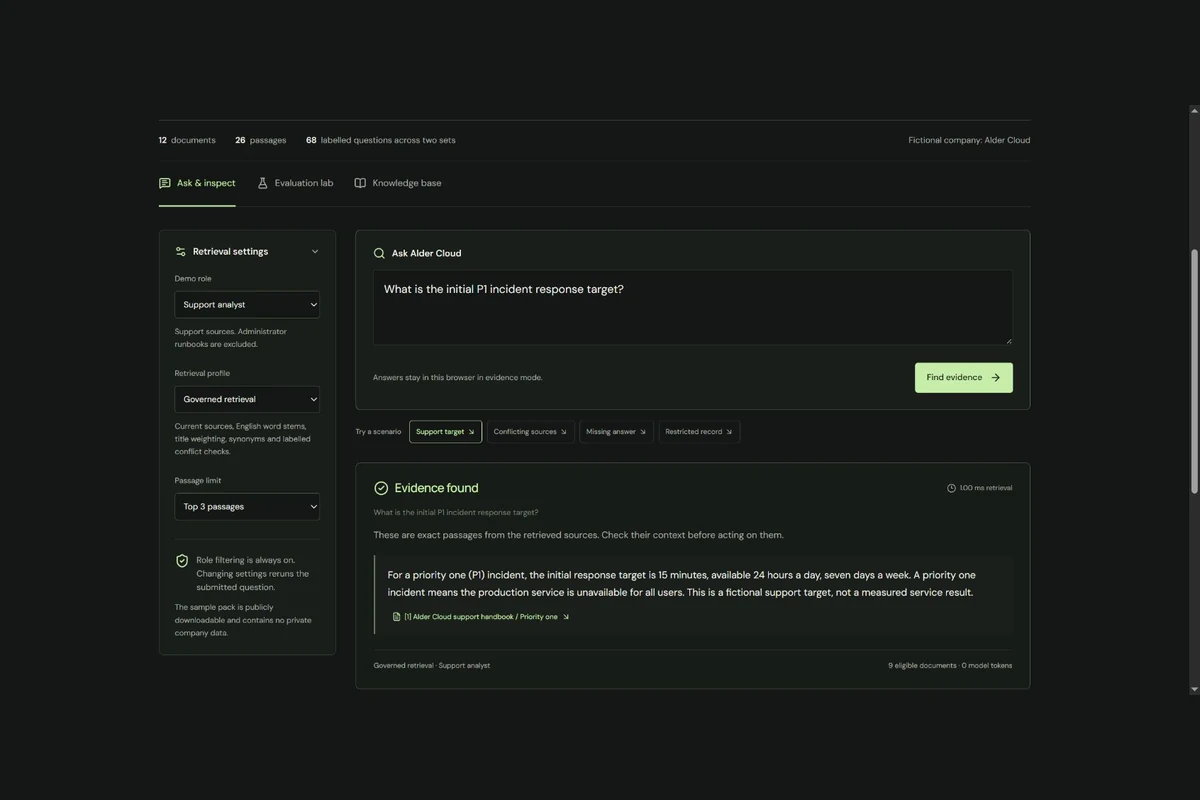
A fluent answer can hide a retrieval mistake. The assistant may have selected a draft policy, missed a contradictory source or found a passage that shares vocabulary with the question but does not answer it. Knowledge Lab separates those decisions so they can be inspected before model generation enters the picture.
Give the retrieval layer an observable result
The public application searches a fictional company knowledge base and quotes exact source passages. A visitor can inspect the document, its owner, status and date, then compare the quoted text with the question. This browser evidence mode works without a model service.
The project includes both a keyword baseline and governed BM25 retrieval. Source-status filters, simulated role filters, coverage checks and conflict handling affect which evidence is usable. Switching configurations exposes changes in the selected evidence and in the decision to answer or abstain.
The distinction is practical. If retrieval cannot find the relevant policy, a different generation prompt does not repair that missing evidence. If two authoritative sources disagree, presenting that disagreement is more useful than selecting whichever passage makes a concise answer easiest.
Test missing answers and conflicting sources
The sample questions include a support target, contradictory policies, an undocumented topic and a restricted synthetic record. These make the system's boundaries visible. The support and administrator options illustrate filtering over a public pack; they are not a security boundary protecting private information.
Earlier retrieval failures are retained in the project records. Two questions originally failed because of English word-form differences. General inflection normalisation corrected those cases. A separate corpus-vocabulary guard prevents an unsupported storage-capacity question from becoming an answer merely because it overlaps with other policy language.
Those are different faults with different remedies. Recording both the original failure and its correction gives a reviewer more information than reporting a final aggregate score alone.
Evaluate generation as a separate step
The optional local path adds a Python and LangChain adapter with Ollama inference. The adapter reloads the canonical source pack, applies its configured role and checks admitted context before calling the model. It does not rely on the browser to declare which passages are permitted.
The accepted local Qwen3 8B run records 68 pipeline cases, 46 generated-answer content checks and seven rejected invalid-context probes. Accepted answers have a source-by-source agent review. These checks look beyond the presence of a citation: the cited source must support the answer and its qualifications.
Describe what the evaluation establishes
The development and verification sets contain 40 and 28 synthetic, agent-authored questions. They are regression coverage. Passing them does not establish general answer accuracy, an independent human benchmark or successful operation on a customer's documents.
Human review was not performed for the accepted version 1 run. The public deployment serves evidence mode; local model results are recorded separately. That separation lets someone assess retrieval behaviour, model behaviour and the quality of the evaluation without confusing them.
Open the public Knowledge Lab, follow the implementation and local setup, or inspect the recorded local-model validation.
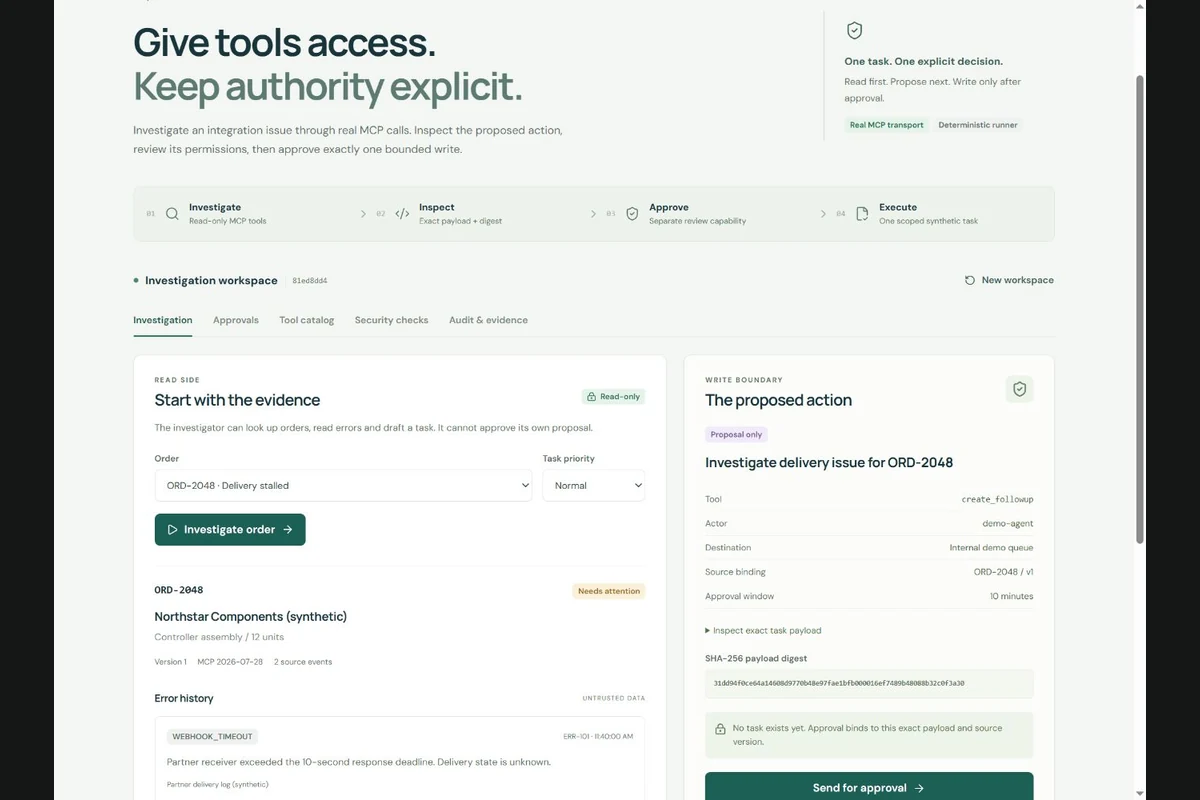
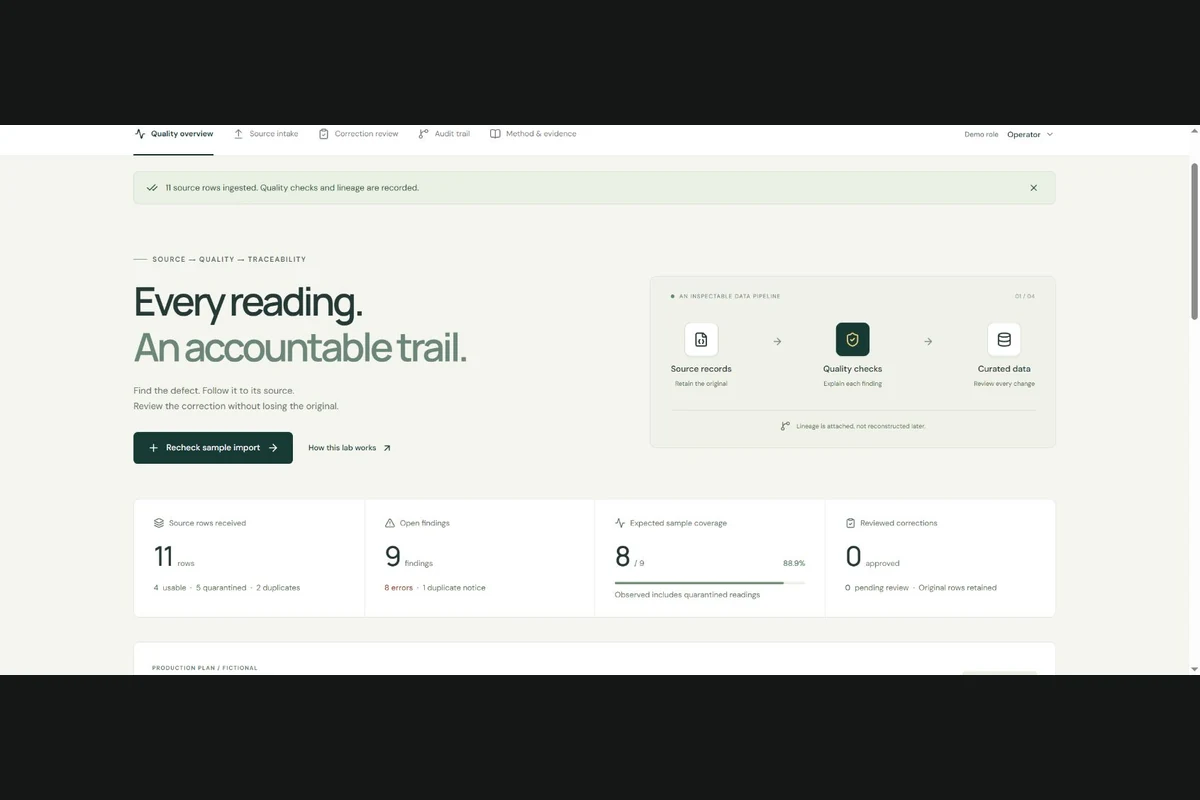
Continue the conversation.
Comments are hosted on GitHub. Load the discussion to read or leave a comment.