

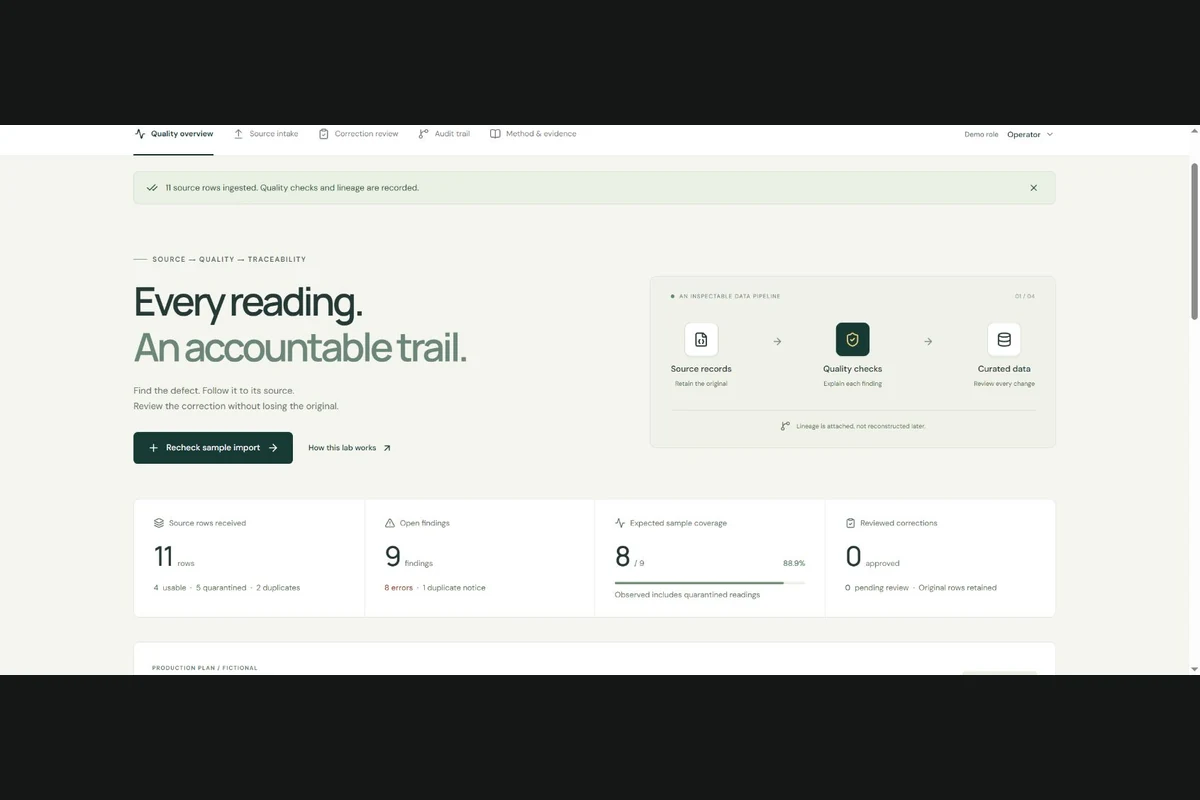
When a measurement has the wrong unit, correcting the current value is only part of the job. Someone investigating it later needs to see the imported record, the reason for the correction and the version that a report used. Keeping that trail makes the correction understandable after the immediate data-quality issue has been resolved.
A useful design separates the received source record from the measurement that downstream users query. The source records what arrived. The current measurement records the interpretation the application has accepted, with a link back to that source and any reviewed changes.
Keep the evidence behind a unit change
In the synthetic
Traceability Lab,
source row MES-004 contains the unit degC. The lab
raises a unit finding. Its fictional source-owner clarification supplies the
evidence for proposing °C as the corrected unit. This is a
reviewed change to the unit label, not a numerical temperature conversion.
The proposal alone leaves the measurement unchanged. A reviewer records a rationale and approves it; the curated measurement then becomes version 2. The original source remains available, and the resolved finding remains in the history. The project walkthrough describes how to inspect each stage.
For a real import, a familiar-looking unit string would be insufficient evidence on its own. The mapping needs support from the source system's specification or its owner. Record that reference with the proposed change so a reviewer can assess the meaning as well as the spelling.
Review the version that will actually change
A correction can become stale while it is waiting for review. Two people might propose different changes to the same measurement, or a separate update might resolve the original problem. Applying a patch against a newer version can overwrite work that its author never saw.
Include the measurement version in the proposal and compare it again when approval is applied. The lab also requires a workspace revision and re-evaluates the patch, rejecting stale changes and changes that do not improve the findings. Its HTTP contract makes those conditions explicit.
When a conflict occurs, show the current measurement alongside the proposed change. The reviewer can then decide whether the proposal still applies. Automatically retrying a stale correction against fresh data skips that decision.
Keep reports connected to their inputs
A report produced before a correction may legitimately differ from one produced afterwards. To explain the difference, retain the measurement versions and the report's input boundary. Depending on the system, that could be a snapshot identifier, a versioned dataset or an explicit list of measurement versions. A query against today's current rows cannot establish what yesterday's report contained.
This does not require every application to adopt event sourcing. Microsoft's event sourcing guidance describes both the value of retained events and the complexity of the pattern. A relational design with retained sources, explicit versions and correction history may be sufficient for the investigation the team needs to support.
State what an export can establish
The lab exports sources, measurements, findings and audit history. Its hash links help detect inconsistent evidence, but an administrator able to rewrite the database and recompute the hashes could rewrite that history. The export is not a digital signature or proof of independent custody.
All lab batches, readings and source-owner statements are fictional. Its switchable roles demonstrate server permission checks, not separate verified people. It makes no product release or regulatory validation decision. Within that scope, it gives a reviewer a concrete investigation: follow a corrected value back to its source, inspect the proposal and explain why the accepted version changed.
Continue the conversation.
Comments are hosted on GitHub. Load the discussion to read or leave a comment.