

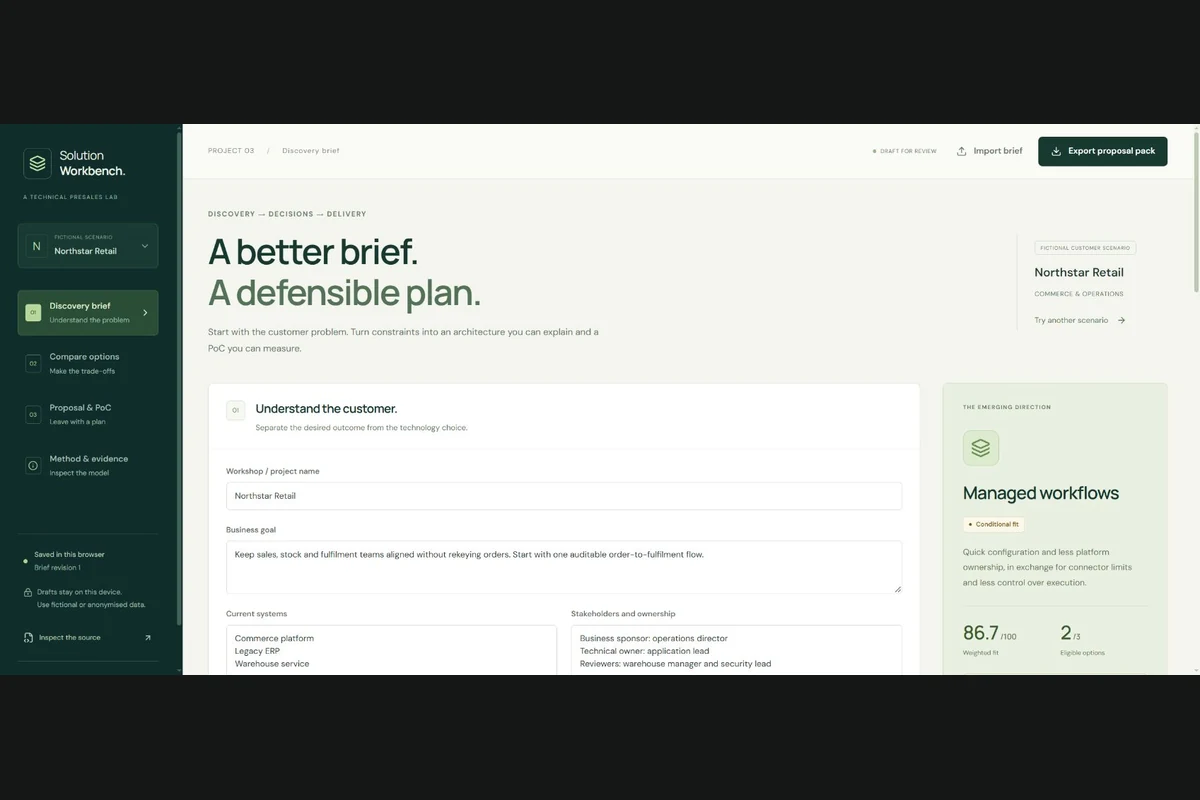
A delivery team should be able to read a presales handover and identify what the customer expects, what has been tested and which decisions still need an owner. Those answers give the team somewhere to start when implementation exposes a dependency that the demonstration did not cover.
The unresolved questions deserve space near the front. An assumption about identity, data access or the customer's operating hours can change the work substantially. If it appears only in someone's meeting notes, the delivery estimate may depend on an agreement that nobody actually made.
Turn the customer expectation into a check
Consider a hypothetical stock integration. The customer wants stock changes visible in the sales application within fifteen minutes. A demonstration sends a prepared file through the integration and shows the updated quantity. That establishes a useful part of the flow. The source system's export schedule still needs checking.
If that system exports once an hour, the integration cannot meet the stated expectation through that interface. Measuring only the time between receiving the file and updating the destination would hide most of the delay. The acceptance check needs a starting point in the source system and an ending point that matches what the customer sees.
Write down which timestamp starts the clock, which destination state stops it, and what happens when the source is unavailable. Keep the fifteen-minute target labelled as a requirement in this example until representative tests establish whether it is achievable. A screenshot of the completed update cannot supply the missing timing evidence.
Keep the reason for a decision
The implementation team also needs to know why an option was chosen. Microsoft's guidance on architecture decision records recommends recording context, alternatives, consequences and decision status. When an accepted decision changes, a linked replacement preserves the earlier reasoning.
For the stock example, a short record could explain that file ingestion was proposed because API access had not been confirmed. It should also say that the freshness requirement remains unresolved. That gives the next architect a specific condition to investigate before accepting the design.
Keep proposed choices distinct from customer-approved scope. Likewise, a dependency listed in a proposal is not evidence that the customer has agreed to provide it. The handover should link to the decision or confirmation that establishes each commitment.
Assign the questions that can change delivery
An open question needs an owner and a point at which the answer becomes necessary. In the example, the source-system owner could confirm the export schedule before the integration estimate is accepted. The customer's service owner could confirm who investigates missing stock updates before a pilot begins. A deadline without a responsible person leaves the dependency open.
Record the consequence alongside the question. If API access is unavailable, does the customer accept slower updates, fund a different interface or stop the proposed approach? This is easier to discuss before a delivery team has committed to a design that relies on the answer.
Give the team something they can use
A compact handover can link to four working records:
- The agreed outcome and the acceptance checks that will demonstrate it.
- The proposed architecture, with accepted decisions and open assumptions.
- The test evidence, including the environment, inputs and known gaps.
- The remaining dependencies, their owners and the decisions they affect.
Presales Workbench provides a synthetic example of some of these records. Its export includes a discovery brief, proposal, proposed decision record and PoC plan. The plan contains future acceptance checks; exporting it does not mean those checks have passed. The project documentation explains that boundary.
Before handing over, ask the receiving team to identify the first test they would run and the first dependency they would chase. If they need the original presenter to reconstruct either answer, add the missing detail to the record while the people who know it are still available.
Continue the conversation.
Comments are hosted on GitHub. Load the discussion to read or leave a comment.