

A proof of concept can answer a focused question: can this data be retrieved, can these systems exchange an event, or can this workflow produce a useful draft? Moving it into production creates further questions about access, recovery and who will investigate a failure. Those questions need evidence of their own.
Record what the demonstration actually established
Start with the tested path and its conditions. A document assistant might retrieve the right passage from a prepared collection under one test account. That result says little about whether another account can access documents it should not see. Likewise, an integration that succeeds with a prepared payload still needs checking against the source system's real interface and failure behaviour.
Keep the evidence close to the claim: the source revision, environment, representative inputs and observed output. Distinguish a completed test from a proposed acceptance check. If the next team cannot reproduce the result, it will spend part of the implementation budget rediscovering what the demonstration meant.
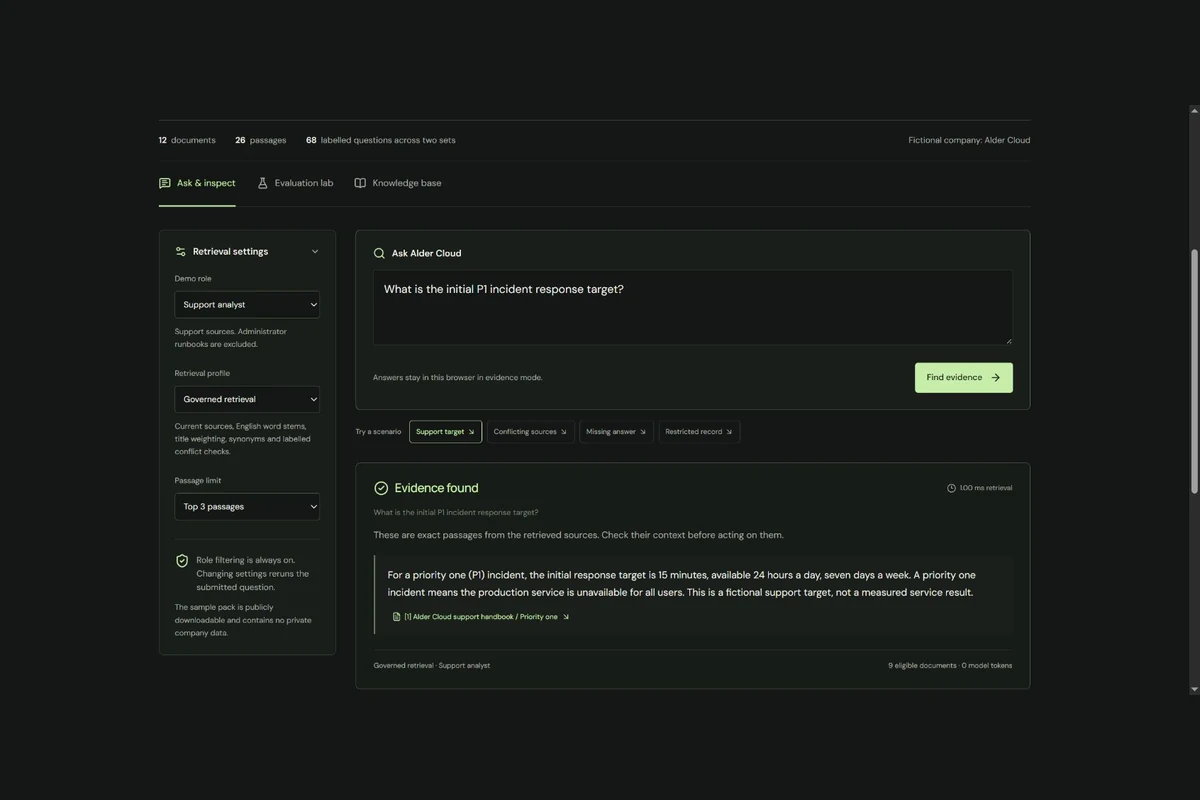
The portfolio's Knowledge Lab keeps a relevant boundary visible. Its public mode displays exact source quotations; optional local inference is a separate path. Evaluating the public evidence interface alone cannot establish the behaviour of generated answers or readiness for an enterprise deployment. The project documentation explains the two paths.
Rehearse a failure with the people who will handle it
Consider a hypothetical internal order assistant. It reads order data and prepares a task for an operator to review. During a rehearsal, make the order service unavailable. Check what the user sees, whether the request can be safely repeated and which evidence reaches the support team.
A useful runbook identifies where to find the failed operation, what the responder may safely retry and when to involve the source-system owner. Exercise it with someone who did not build the feature. Each missing permission or unexplained log field is work the team can resolve before a customer depends on the service.
AWS's operational readiness review guidance recommends using lessons from operational incidents to shape review questions. For a particular service, those questions should reflect its own dependencies and known failure modes. A generic checklist is a starting point; the rehearsal supplies evidence about this implementation.
Define how the pilot can stop
Agree which users and data belong in the first release, who owns the decision to expand it, and which observations would stop it. For the order assistant, an unauthorised order lookup should halt the pilot for investigation. Slow responses need a different assessment against the agreed service target. Treating every issue as a single overall success score obscures the action each one requires.
Google's SRE guidance on canarying describes evaluating a change through a limited deployment before wider rollout. It also explains why the traffic sample, duration and chosen metrics affect what the evaluation can reveal. A quiet pilot with a few successful requests gives limited evidence about peak conditions.
Work through the exit procedure too. Disabling the assistant may stop future actions while leaving tasks it already created. A rollback plan should say which changes can be reversed and which require reconciliation. Check that the responsible operator can perform those steps with the permissions they will actually have.
Make the remaining work estimable
Turn each gap into a delivery item with an owner and an acceptance check. For the example assistant, that could mean verifying access against real organisational roles, rehearsing source-service failure, confirming how duplicate tasks are prevented and testing the pilot's shutdown procedure. Include the customer dependencies needed to perform those checks.
The production decision can then name the evidence available, the work still open and who accepts any remaining limitation. The PoC retains its value as a focused technical result, and the implementation estimate has a concrete basis for the work that follows.
Continue the conversation.
Comments are hosted on GitHub. Load the discussion to read or leave a comment.