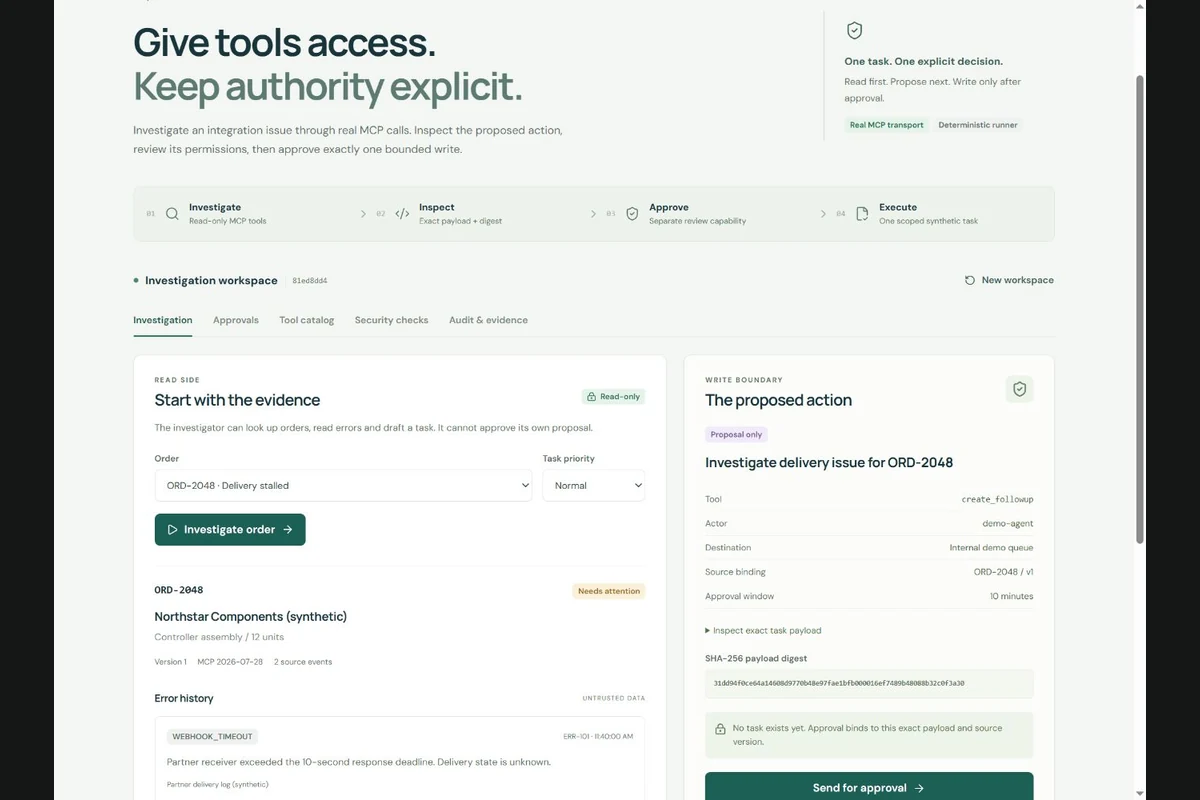
The public application with synthetic example data.
01 / FUNCTION & ABILITIES
Give tools access. Keep authority explicit.
01
Use genuine MCP tools
Discover strict schemas, look up an order, read untrusted error history and draft a deterministic follow-up over real MCP HTTP calls.
02
Inspect the exact proposal
Review the task body, fixed queue, source order version, actor, resource, payload digest and ten-minute approval window.
03
Enforce the write boundary
Separate capabilities govern reading, execution, proposal requests and review. The server rejects pending, rejected, stale, tampered and unscoped writes.
04
Verify what happened
Run five live denial probes, inspect captured protocol bodies and verify a hash-linked audit and six-file evidence export.
02 / PLANNED BOUNDARIES, VISIBLE FLOW
From the whiteboard to a working application.
Play a scenario, step through the decisions or select a component to inspect its responsibility. The diagrams follow the implemented design.
THE ARCHITECTURE BOARD05 / Workflow Lab
Illustrated flow
Step 1 / 8 · click any component
FOLLOW THE FLOW
Connect with read scope
The SDK negotiates MCP and uses the reader capability for investigation.
Read all 8 steps without animation
A proposed action acquires authority only through a separate explicit decision.
This is a fixed investigator plan using real MCP. The lower lane shows a separate demo review capability, not a second verified person. Animation illustrates the design, not live server telemetry. Arrows and moving dots are an explanation of the implementation, not live telemetry.
Run Investigate order. Inspect the source errors, exact task payload and real request/response bodies in the MCP wire inspector.
02
Send the proposal for review
Select Send for approval. Try Execute MCP call while pending and observe the server denial. A Controller approval attempt also fails.
03
Approve the bounded action
Switch the demo review capability to Reviewer, enter a reason and select Approve exact task. Approval itself does not execute the write.
04
Execute and replay
Execute the MCP call to create the synthetic internal task. Replay the same call and confirm that it returns the existing task.
05
Challenge the boundaries
Run Security checks, then investigate ORD-2057's untrusted injection fixture. Download the evidence ZIP and verify its evidence.json through the file chooser.
04 / ENGINEERING JUDGEMENT
Why it works this way.
Separate data from authority
Partner error text is displayed as untrusted evidence. A fixed template uses allowlisted identifiers and codes; retrieved text cannot grant permissions.
Bind approval to the exact action
The immutable proposal binds payload hash, workspace, actor, resource, source version and expiry. Execution revalidates every binding.
Commit once, replay safely
One optimistic SQL update consumes the approval, creates the task, advances the order version and appends its audit. Replay reads the existing task.
05 / INSPECT THE EVIDENCE
Tested behaviour. Explicit limits.
40 unit tests and 34 HTTP scenarios per local/public target exercise audience, scope, malformed input, rejection, tampering, staleness and concurrent execution.
20 local and 14 public browser checks include actual download, independent extraction, evidence re-import and mobile layout.
Local restart and public redeployment checks retain the original capability, task, proposals and complete audit state.